Sea turtle nests detection
- Project Context: Sea turtles, including species like the green sea turtle, are critically protected within French waters and on its southern coastline. While known nesting populations exist in the Mediterranean, confirming and monitoring new or sporadic nesting events in areas like Southern France is crucial for understanding species distribution, population health, and implementing effective conservation measures. The elusive nature of these nesting activities often presents significant challenges for traditional survey methods.
- Our Objective: Our team was contracted by CestMed to contribute specialized canine detection capabilities to their efforts in the South of France. Our primary objective was to accurately locate and confirm the presence of sea turtle nests on the southern beaches, thereby providing essential data to support the conservation status and management plans for these protected animals in the region.
- Innovative Methodology & Training: A key challenge for this project was the inherent scarcity of real-world sea turtle nest samples for canine training within the target area in France. To overcome this, we implemented a unique training strategy:
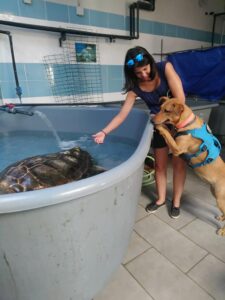
- Our detection dog was deployed to Kyparissia Bay, Greece, one of the Mediterranean’s most significant sea turtle nesting sites. This highly active environment managed by Archelon provided an invaluable opportunity for the dog to receive intensive, real-world imprinting and training on the specific scent of actual sea turtle nests.
- Following this specialized training in a high-density nesting area, our highly proficient detection dog returned to the southern beaches of France.
- Once back in France, the dog meticulously aided ground searches, leveraging its newly acquired, scent detection skills to efficiently locate subtle and elusive sea turtle nests.
Outcome & Impact: Our unique approach significantly enhanced the capabilities for sea turtle nest detection in Southern France. By successfully applying canine detection methodologies, we were able to aid CestMed’s efforts in proving the presence of nesting, contributing vital data that reinforces the need for ongoing protection and monitoring of sea turtles in French coastal habitats. This project exemplifies how targeted, adaptive canine training can provide critical solutions to complex conservation challenges, especially when working with rare and protected species in new geographical contexts.