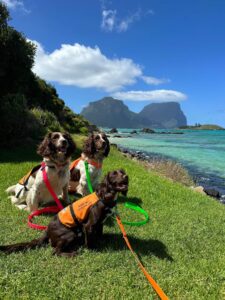
Lord Howe Island Board Eradication Program
- Project Context: The Lord Howe Island Rodent Eradication Project (REP), managed by the Lord Howe Island Board in Australia, stands as one of the most ambitious and successful island eradication initiatives globally. Following 15-20 years of meticulous planning, the intensive operational phase from 2019 to 2021 aimed to eradicate introduced Ship Rats (Rattus rattus) and House Mice (Mus musculus) from this UNESCO World Heritage-listed island. The project is crucial for protecting Lord Howe’s unique and endemic flora and fauna, many of which are found nowhere else on Earth. The island was officially declared rodent-free in late 2023, a monumental conservation achievement.
- Our Objective: As a dedicated Biosecurity Detection Dog Handler, I integrated into the Lord Howe Island Board’s existing biosecurity team. My primary objective was to contribute specialized handling expertise and support the team’s critical non-invasive detection capabilities for invasive rodents, encompassing post-eradication verification, rapid response to potential re-introductions, and establishing robust ongoing biosecurity measures.
- Methodology: My role involved working alongside the existing team, which comprised four different detection dogs, in the strategic deployment of these highly trained biosecurity detection dogs across various critical phases of the eradication and post-eradication monitoring:
- Post-Baiting Surveys: Conducting systematic sweeps to confirm the absence of surviving rodents after the initial baiting phase.
- Incursion Response: Rapidly deploying in response to any suspected rodent sightings. For instance, detection dogs were instrumental in locating breeding rats during the critical April 2021 re-invasion event, allowing for swift and effective mitigation.
- Ongoing Biosecurity Surveillance: Regularly screening all incoming cargo, luggage, and vessels at high-risk entry points (e.g., wharf, airport) to prevent future re-invasions.
- Low-Density Detection: Leveraging the superior olfactory capabilities of the detection dogs to identify rodents even at extremely low population densities, far exceeding the detection limits of other methods.
- Outcome & Impact: The team’s confirmed detection of rodent presence during re-invasion events enabled immediate and targeted responses, preventing the re-establishment of invasive populations. The collective ongoing surveillance work has been instrumental in maintaining the island’s rodent-free status, directly contributing to the remarkable ecological recovery observed (e.g., rebound of native birds like the Woodhen, increased plant regeneration). This project serves as a global exemplar for effective island biosecurity and invasive species management, and the team’s contribution was a core component of its success.
- Recognition: The Lord Howe Island Rodent Eradication Project received a prestigious Froggatt Award for its outstanding achievements in environmental pest control.